For most of the last decade, padel grew up in converted warehouses and pay-by-the-hour clubs. In 2026 the fastest-moving address for a new court is somewhere else: the hotel. Singapore’s METT opened with two green courts set against its heritage building. Marbella’s Puente Romano runs eight floodlit glass courts inside its tennis club, with its restaurants and bars placed exactly where tired players end up. Beaverbrook in Surrey has offered padel since 2018 and, according to reporting in The Observer, runs bookings at 80 to 90 per cent occupancy. Badrutt’s Palace in St Moritz installed a combined tennis-and-padel surface at roughly 1,850 metres above sea level. Across the Atlantic, The Ritz-Carlton Key Biscayne, Rancho Valencia and Parker Palm Springs all treat the sport as part of the guest offer rather than an afterthought.
That shift matters more than it first appears. A club buys a court to sell court time. A hotel buys a court to change how a guest spends a day — and the specification that follows from those two motives is genuinely different. For court manufacturers and turnkey suppliers, including international padel court solution brands such as akeepo, hospitality has quietly become one of the most demanding briefs in the market.
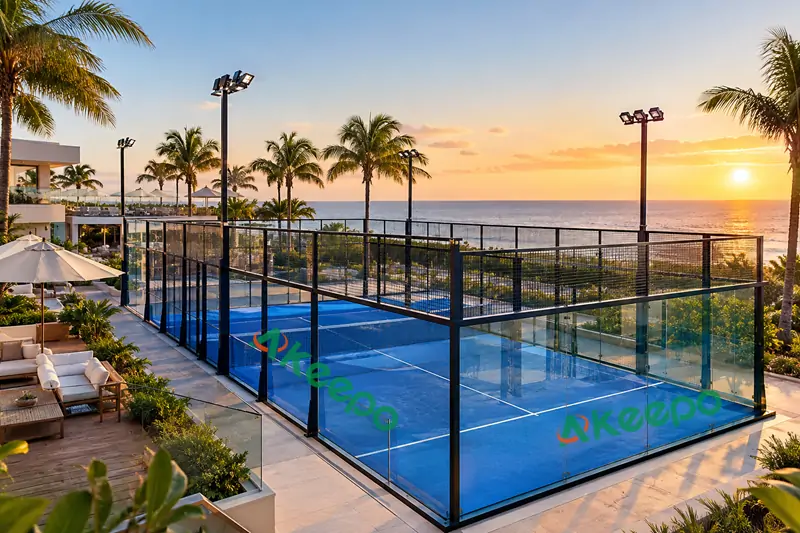
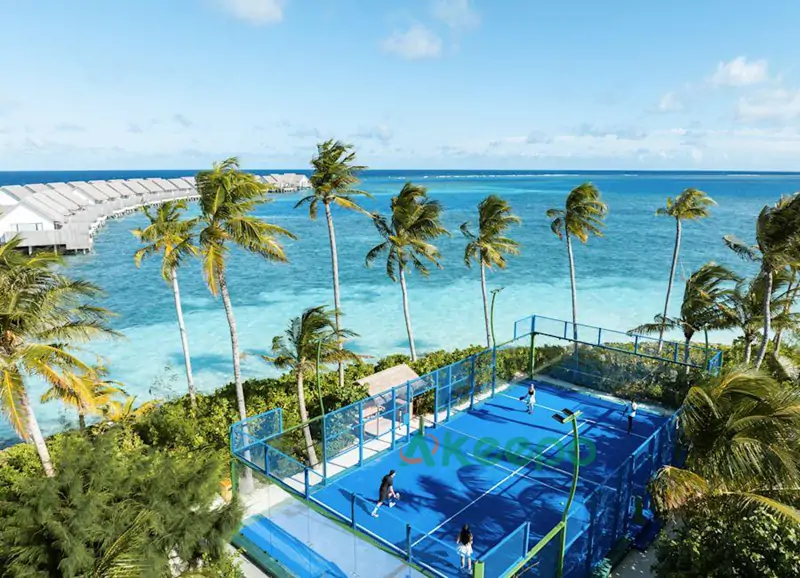
A resort court has to work twice: as a playing surface, and as the view from the terrace. (Reference image: akeepo padel court project)
1. Why a hotel wants a court at all
The commercial logic is easier to follow if you stop thinking about padel and start thinking about the guest’s afternoon. Four people, ninety minutes, one court — then lunch, then the spa, then dinner. The court does not compete with the restaurant. It feeds it.
· Space economics. A standard padel court occupies 20 by 10 metres. Two or three can usually be fitted into the ground a single tennis court takes up, which means a resort can add a new activity without surrendering its best lawn.
· Dwell time and ancillary spend. A round of padel produces four hungry, thirsty guests who are already on site and already in a good mood. Few amenities produce that reliably.
· A very short learning curve. Unlike tennis, a first-timer can hold a rally within fifteen minutes. That matters enormously when your clientele changes every three nights and cannot be assumed to own a racket.
· Content. Glass walls reflect palm trees, sea light and sunset. Guests photograph the court without being asked, and hotels have learned that this is cheaper than any advertising campaign.
· Measurable pull. Properties that publish their occupancy numbers, such as Beaverbrook, show that the court is not a decorative extra — guests book stays around it.
The pattern is now global rather than European. Amanpuri in Phuket pairs two padel courts with four tennis courts. Amanyara in Turks and Caicos lists padel alongside tennis, pickleball and water sports. Le Royal Méridien Beach Resort in Dubai offers both padel and pickleball to hotel guests. W Bali went further and wrapped two courts in a Lacoste collaboration with a retail boutique attached — the court as brand statement. Even city hotels with almost no land are finding room: the METT squeezed two courts into a plot beside Fort Canning Park.
2. The space calculation that makes it possible
Most hospitality projects are not limited by budget first. They are limited by the site. This is where padel has an unusual advantage, because the numbers are forgiving compared with almost any other racquet sport.
A court is 20 metres long and 10 metres wide. Once you add the safety run-off around the glass and the structural frame, the finished footprint typically lands at roughly 23 by 13 metres per court. Add clearance: six metres of height at the net line is the working minimum for an open court, and more once a canopy or roof structure goes on top. Where the plot is genuinely tight — a pool deck, a rooftop terrace, the gap between two wings — a single-court layout of around 200 square metres can still be made to work, which is how city hotels are entering the category at all.
The practical consequence is that a resort with one ageing tennis court has a decision to make: resurface it again, or come back with two padel courts, spectator seating, shade and a proper service path. In 2026 a growing number of properties are choosing the second option.
3. What changes when the client is a hotel
This is the part that separates a resort project from a club project. Eight items appear in almost every hospitality brief.
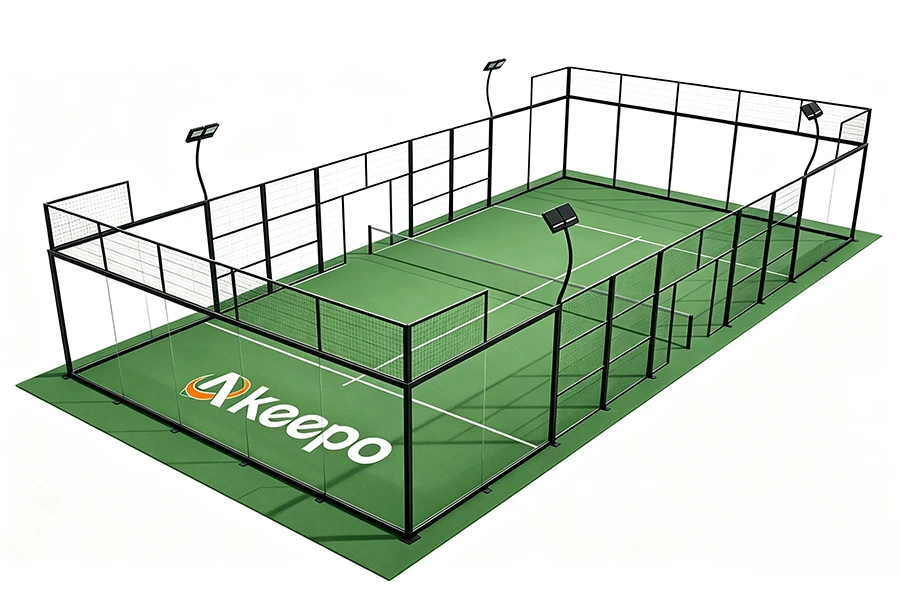
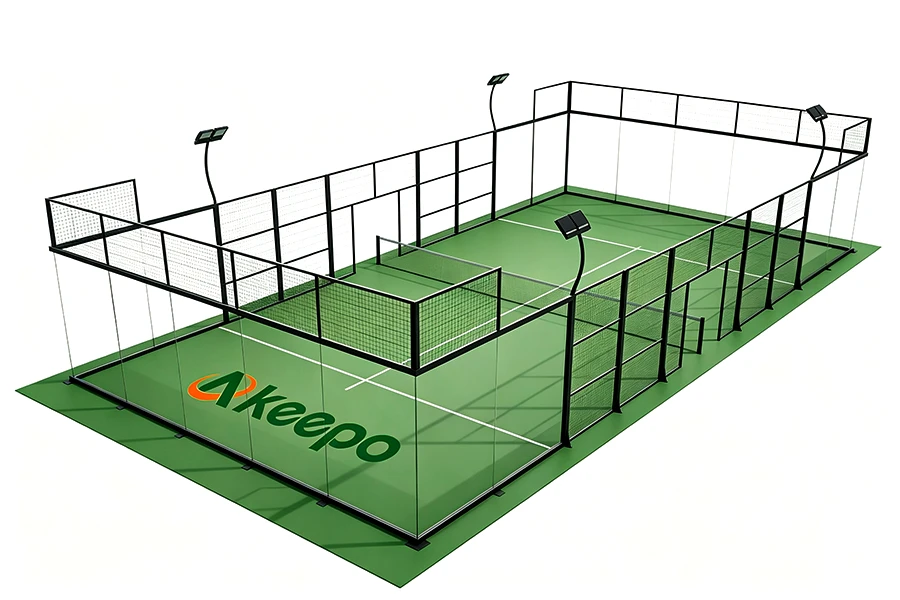
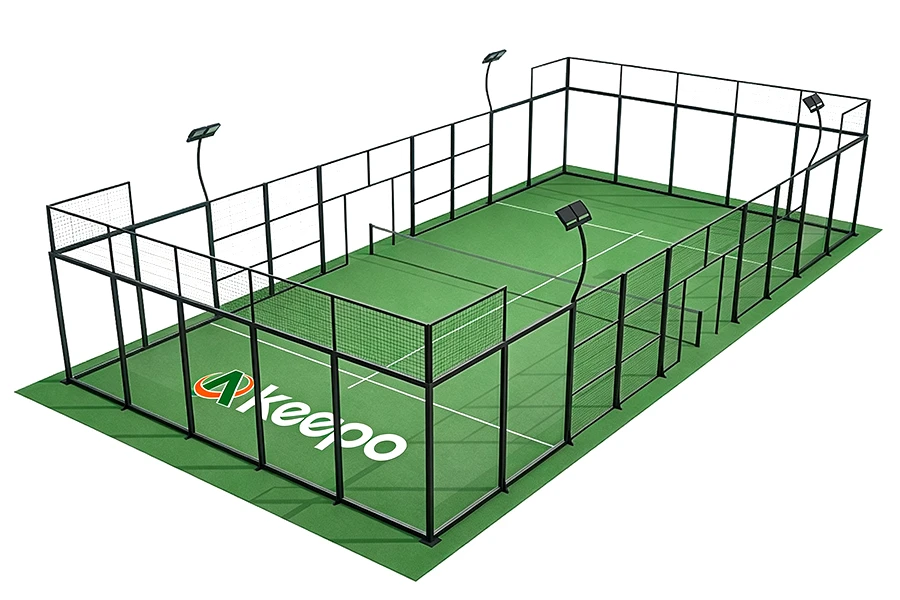
· Glass and sightlines. In a club, a post in your field of view is an annoyance. In a hotel, it is a design failure, because the court is watched from a bar terrace by people who are not playing. Full panoramic construction, with the structural posts set outside the glass, is not a luxury upgrade here — it is the reason the amenity works.
· Wind load and salt air. Coastal properties need engineered wind-load calculations, hot-dip galvanised steel and marine-grade fixings. A “standard export specification” copied from an inland project will corrode and, in a typhoon or hurricane zone, may not be insurable.
· Weather cover. In tropical and monsoon markets a canopy is about rain and UV, not cold. Two covered courts can keep an amenity open through a season that would otherwise close it.
· Lighting as revenue. The slots a hotel can actually sell are late afternoon and evening, after the beach and before dinner. That demands uniform, glare-controlled lighting designed with the guest rooms in mind — a court that floods a suite with light at 9pm will be switched off by the front office, whatever the engineering drawings say.
· Surface and infill. Resort guests play in clothes they did not bring for sport. Low-infill or infill-free turf reduces dust, keeps whites white and cuts laundry complaints; good drainage means the court reopens twenty minutes after a downpour instead of the next day.
· Acoustics and privacy. Glass is a hard reflector. On a site with villas or residences nearby, orientation and barriers belong in the plan from the first sketch, not in the variation order.
· Maintenance by generalists. No resort hires a padel specialist. Specify replaceable panels, accessible fixings, standard spare parts and a maintenance routine a grounds team can actually follow.
· Visual fit. Frame colour, turf shade and court branding are part of the architecture. The best hospitality courts look as if they were designed with the building, not delivered to it.
4. The mistakes that keep appearing in hotel tenders
Having reviewed a fair number of resort enquiries, the same five gaps come up again and again — and each one is expensive to fix after the concrete is poured.
· Buying from a render. Beautiful images, no glass specification, no steel section schedule, no wind certificate. Ask for the technical package, not the brochure.
· No service access. A court wedged between a pool and a retaining wall cannot have a glass panel replaced. If a crane cannot reach it, plan for it now.
· Under-lit then surprised. The cheapest lighting package usually produces the worst evening experience, and evening is where the margin is.
· Nowhere to sit. Without shade, seating and a path to the bar, nobody watches — and the social value that justified the court quietly disappears.
· Ignoring the base. A court that ponds after rain is a closed amenity, and drainage is the one item that cannot be retrofitted cheaply.
5. Where a supplier should add value, not just tonnage
The difference between a good and a mediocre hospitality court is rarely the steel. It is the sequence: site survey, court orientation against sun and prevailing wind, structure selection, foundation drawings, lighting layout, delivery plan, installation supervision. A supplier who only quotes square metres pushes all of that risk back onto the hotel’s project manager, who has probably never built a padel court before.
This is the model akeepo works to for resort and club clients: structure options from full panoramic to classic framed and covered tent courts, tempered glass, turf and lighting specified as one system, and documented drawings for the local contractor to build against. For a property adding its first court, the useful question is not “how much per square metre” but “what does the finished, playable, insurable facility include” — and which of those items will still be available as a spare part in five years.
On structure selection specifically, the panoramic option (akeepo panoramic padel court) tends to win in hospitality because the view is the product; a classic court wins where the budget is fixed and the client is a school or a community centre; a covered court wins wherever the weather, not the guest, decides the calendar.
6. Seven questions to ask before the deposit
1. What wind speed is the structure engineered and certified for, and who signs that calculation?
2. What is the glass specification — thickness, tempering standard, panel span — and what happens when one panel breaks?
3. How many lux at court level, and what is the light spill at the nearest guest window?
4. What is the finished footprint including run-off, and can a maintenance vehicle reach every side?
5. How is the base built, and at what slope does water leave the surface?
6. What is the delivery format — how many containers, what lead time, who supervises installation?
7. What is the warranty, in writing, and what exactly does it exclude?
Bottom line
Padel has spent ten years proving it can fill courts. In 2026 it is proving something more commercially interesting: that a court can change the shape of a guest’s day, and with it the value of a room night. Hotels that treat the court as an amenity — sited, lit, shaded and finished like the rest of the property — are getting occupancy and content out of it. Those that treat it as equipment dropped onto spare ground are getting a maintenance line. The difference is decided long before the first container arrives, in a specification nobody photographs.
Back to News Start Your ProjectRecommended Products