Glass and Steel: How to Inspect the Two Components That Are Half Your Budget
You do not need a laboratory to inspect a padel court. You need a tape measure, a torch, a magnet — and the discipline to ask five uncomfortable questions before a container is sealed. Here is the checklist that experienced operators run, component by component.
The posts and frames are the skeleton of the court, and the single most important specification is tube wall thickness. FIP-compliant structures typically use posts of 3.0–4.0 mm wall thickness (often 80×80 mm or 100×50 mm section); budget builds quietly substitute 2.0–2.5 mm tube, which flexes on ball impact and fatigues years earlier.
Three on-the-spot checks:
- Measure, don't trust the label. Ask for a caliper reading on a cut end of the actual production tube, not a datasheet. A 0.5 mm "rounding error" across a whole court is hundreds of kilograms of steel missing.
- Test the coating. Hot-dip galvanizing followed by a powder coat of 60–80 microns is the durability standard, especially for outdoor court and coastal sites. A coating gauge costs less than one replacement post.
- Look at the sections. Pre-galvanized sheet bent into a box section leaves raw, unprotected edges; fabricated and then galvanized tube protects every face, including the weld zone.
Weld Seams: The Story Is in the Bead
Welds are where steel courts quietly fail — at the mesh-to-frame joints and the post-to-base plates, where every smash sends a shockwave.
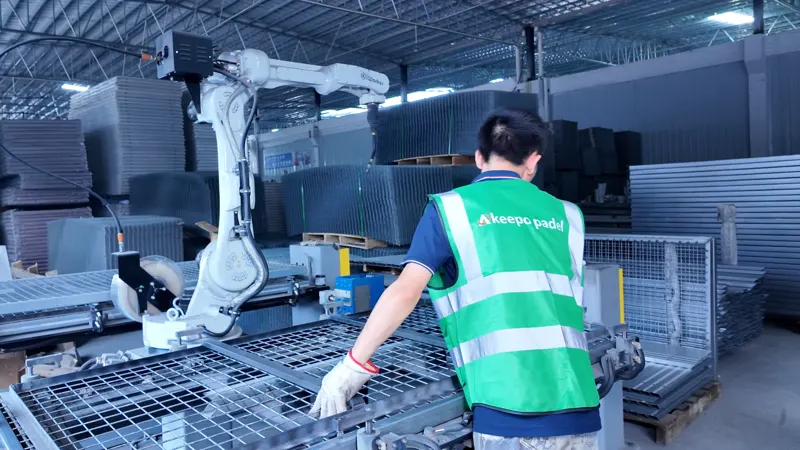
- Uniformity is the tell. A robotic weld bead is even, continuous and repeatable across hundreds of panels; irregular hand welds with porosity, undercuts or spatter point to inconsistent quality control.
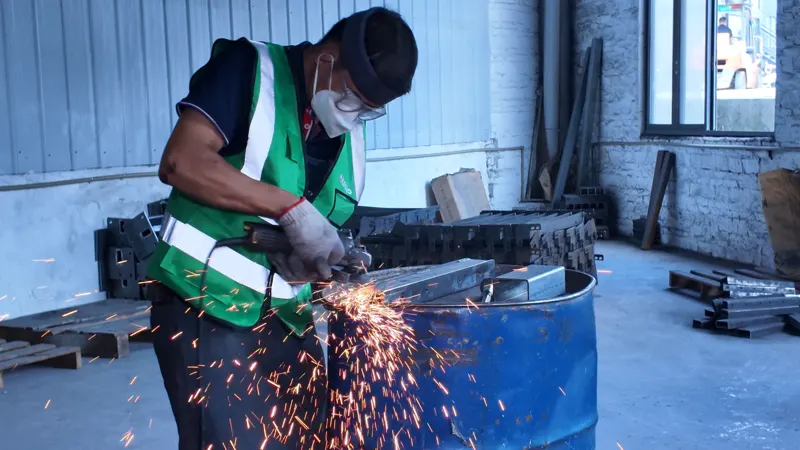
- Watch the grinding. After welding, every joint should be ground and deburred smooth — first for player safety, and second because a ground weld exposes porosity and cold joints that would otherwise hide under paint.
- Check the mesh joints. Wire mesh should be welded to the frame at every intersection zone, then coated; loose or spot-tacked mesh rattles loose within two seasons.
Tempered glass walls of padel club are a quarter of your budget and 100% of your ball-bounce. The 2026 market standard, aligned with FIP specifications:
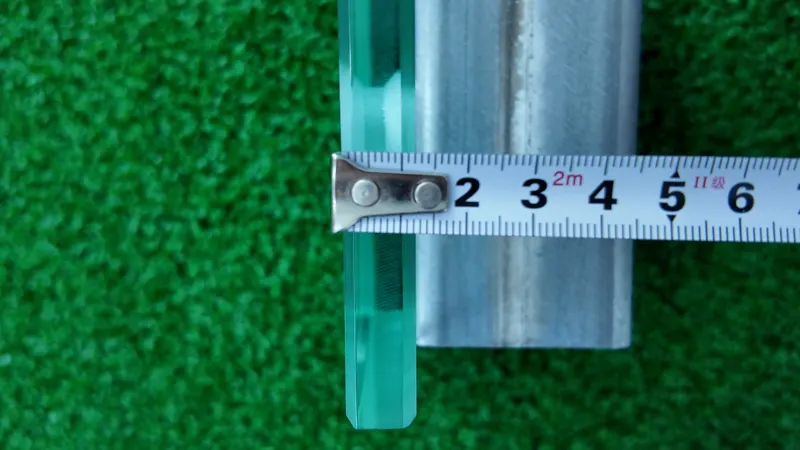
- Thickness: 10 mm for back walls and standard sections, 12 mm where spans and loads demand it (long panoramic panels, door sections). Verify with a tape or caliper on the panel edge — as our inspection photo shows, it takes ten seconds.
- Edges must be finished. Every panel should carry ground or polished edges — bright, glossy, smooth to the touch. A seamed or raw-cut edge is an unfinished edge, and tempered glass with damaged edge work can crack spontaneously months after installation.
- Holes before tempering, never after. Lifting holes and fixing holes must be drilled and polished before the glass is tempered. Drilling tempered glass is impossible — so any retro-drilled panel is a counterfeit claim.
- Demand the certificate. Ask for EN 12150-1 (or equivalent) tempering certificates with batch numbers, and for premium projects, Heat Soak Test (HST) reports — the process that forces out panels containing nickel sulfide inclusions before they ever reach your site.
The Ten-Minute Pre-Shipment Checklist
| # | Check | Pass Looks Like |
|---|---|---|
| 1 | Post wall thickness | 3.0–4.0 mm on a caliper, cut end of production tube |
| 2 | Coating | Hot-dip galvanized + 60–80 μm powder, gauge-verified |
| 3 | Weld beads | Uniform, spatter-free, no porosity after grinding |
| 4 | Glass thickness | 10 mm / 12 mm verified on the panel edge |
| 5 | Glass edges | Ground or polished, glossy, chip-free |
| 6 | Certificates | EN 12150-1 batch certs (HST for premium builds) |
| 7 | Documentation | Photos & video of the packed court before sealing |
Why Akeepo Inspects Panel by Panel
Akeepo runs robotic welding for mesh panels, 100% post-weld grinding, and panel-by-panel glass verification before export — and documents every container with photos and video, so the court that arrives at your site is the court that passed inspection. Because when steel and glass are half the budget, "trust us" is not a quality system; a checklist is.
Back to News Start Your ProjectRecommended Products