Padel Goes Public: From a £5m Council-Funded Hub in Kirkby to District Tenders in Pakistan, Tax Money Is Now Paying for Courts
For most of the past decade, padel courts appeared wherever private money moved fastest: membership clubs in Madrid, investor-backed hubs in Stockholm, boutique venues in London. This autumn, the pattern is changing in a way court buyers and suppliers should not ignore. Some of the most interesting court projects announced or advanced in late October 2026 are not private clubs at all. They are council-funded leisure facilities, government regeneration schemes, and — most striking of all — municipal tenders in places where padel barely registered two years ago. When public budgets start paying for courts, the market stops being a niche and becomes infrastructure.
1. Kirkby: £5 million of public money for eight courts
The clearest example comes from Merseyside. Knowsley Council has confirmed a new 32,000 sq ft padel facility at Newton Gardens, in the heart of Kirkby, accommodating up to eight courts alongside changing rooms, a café and community social space. The funding structure is what makes headlines: £2.5m committed in June 2026 from the government's Pride in Place programme — part of a £19.5m ten-year award the town received in 2023 — matched by £2.5m of council capital funding plus land valued at roughly £500,000. That is £5m of public money aimed squarely at padel.
Two details matter for anyone watching the market. First, the council is still in "advanced dialogue" with a preferred operator who will invest in running the facility — the public-private split is becoming the standard template: public money builds, private operators run. Second, the council has stressed the space will be "fully accessible", targeting a family leisure offer in the town centre, with operations targeted for the end of 2027. Padel is being positioned not as a premium members' sport but as ordinary civic amenity, on the same shelf as a swimming pool or a library.
2. Telford: padel added to a 50-year-old municipal tennis centre
A second British example shows the retrofit route. Work has officially started on new padel courts at Telford Tennis Centre, delivered by We Do Tennis in partnership with Telford & Wrekin Council's leisure services team. Subject to construction progress, the courts are expected to open by the end of October 2026 — meaning very soon after this article's date.
The commercial logic here is different from a standalone club. Co-director Nigel Hunter notes the venue will be the only local site where residents can play tennis, padel and pickleball, with "affordable courts for the local community" and social sessions built in. For councils that already own tennis infrastructure, adding padel is a lower-risk entry than building from scratch: existing parking, existing footfall, existing coaching staff to cross-train. Expect many more municipal tennis centres to follow this path through 2027, because the marginal cost of two or three courts on an existing site is far easier to defend in a council budget than a full facility.
3. Rajanpur, Pakistan: padel courts in a district tender document
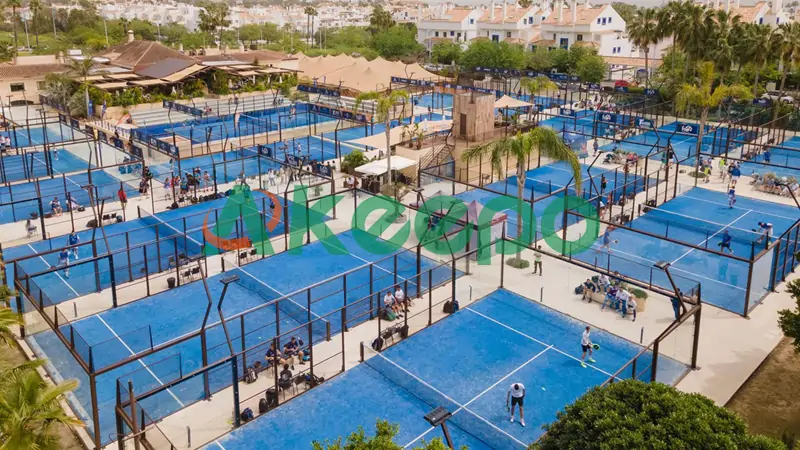
The most surprising evidence of padel's mainstreaming comes from Punjab, Pakistan. The District Council of Rajanpur invited bids for a package of civil works worth an estimated Rs 108.1 million — and inside that package sit two separate line items: construction of a padel court at MC Jampur (Rs 32.39 million) and another at MC Rajanpur (Rs 32.79 million), with online bids closing on 27 October 2026 under the provincial e-procurement system.
Read that again: padel courts specified alongside water supply schemes, bus shelters and road works in a rural district procurement notice. Whether or not these particular projects proceed on schedule, the signal is unmistakable — padel has entered the vocabulary of public works planners far beyond Europe and North America. For manufacturers and exporters, provincial and district tenders like this are becoming a channel worth monitoring, and they reward suppliers who can produce clear technical specifications, compliance documentation and competitive per-court pricing in tender-ready formats.
4. Cincinnati: the private-sector counterpart, and why a roof keeps winning
Across the Atlantic, the same month produced a useful contrast. Cincinnati Sports Club, a 16-acre members-only racquet club, is adding two covered outdoor padel courts on its Fairfax campus as part of the largest reinvestment in the club's 36-year history, under a master plan it calls Club Vision 2040. They will be the city's second venue inside the city limits and the metro's third, following Club Padel Newtown's four outdoor courts at a $15 million park complex and the two glass-walled courts opened by the Cincinnati Open Sporting Club in Mason in March 2026.
What should hold the attention of court buyers here is not the count but the covering. As Padel Browser points out, every other padel court in Greater Cincinnati sits in the open air, which makes the shoulder seasons a gamble; a canopy turns November and March "from write-offs into playable months" without the cost of a fully enclosed building. That same calculation — modest capital outlay, materially higher annual utilisation — is exactly what makes canopied courts the default answer in temperate climates, whether the budget comes from members' dues or the public purse.
 5. Balbriggan: tracking the pipeline through planning registers
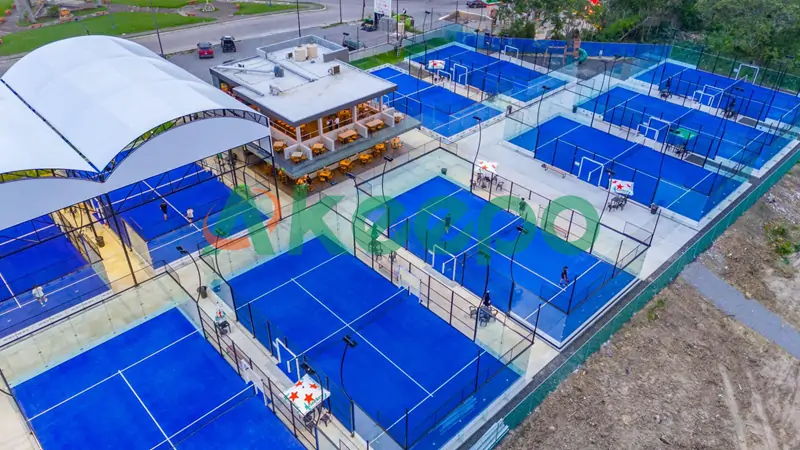
One more datapoint, this time from Ireland. A planning application lodged with Fingal County Council on 25 September 2026 proposes four new padel courts — three of them with canopy roofs — plus an associated amenity building at Balbriggan Business Campus, with a council decision due by 19 November 2026. Individually it is a modest project. Collectively, applications like this are how the next wave of construction becomes visible months before any press release: planning registers, tender portals and council minutes are now among the best leading indicators of where courts will be built next.
Bottom line for court buyers
Public funding changes the buying process, not just the payer. Council projects run on procurement timelines, require documented specifications, and increasingly carry accessibility obligations — Kirkby's "fully accessible" commitment echoes UK PADEL's decision to make every court at its new Milton Keynes venue adaptive-padel ready. For clubs, schools and municipalities planning a padel project, the practical advice is unchanged: define the court specification early (structure type, canopy versus full enclosure, glazing, turf and lighting), verify supplier certifications, and ask for references from comparable public or community builds. At akeepo we work with buyers at exactly this stage — turning a budget line into a buildable court — and the projects above show that stage arriving earlier, and from more directions, than ever before.
Private capital built padel's first hundred thousand courts. The next hundred thousand may well be signed off in council chambers and provincial tender portals. Anyone selling or buying courts should start reading those documents now.
Back to News Start Your ProjectRecommended Products